How to Master Deep Learning w Learning Resources, Plan, and Goals
Every year, millions enroll in AI and deep learning courses, but many drop out before even finishing half of the course, not because they lack intelligence but because they are overloaded with information.
Terms like back propagation, gradient descent, and transformers hit beginners all at once, without context, and momentum fades.
Deep learning is not magic; it is layered mathematics, structured experimentation, and pattern recognition built step by step. The professionals who succeed do not rush into complex architectures first. They master fundamentals, apply them in small projects, test assumptions, and let intuition develop through practice.
If you approach it the right way, deep learning becomes less intimidating and more gradual progress.
Here’s a roadmap designed to turn overwhelm into clarity—and curiosity into real capability.
I. Foundations of Deep Learning
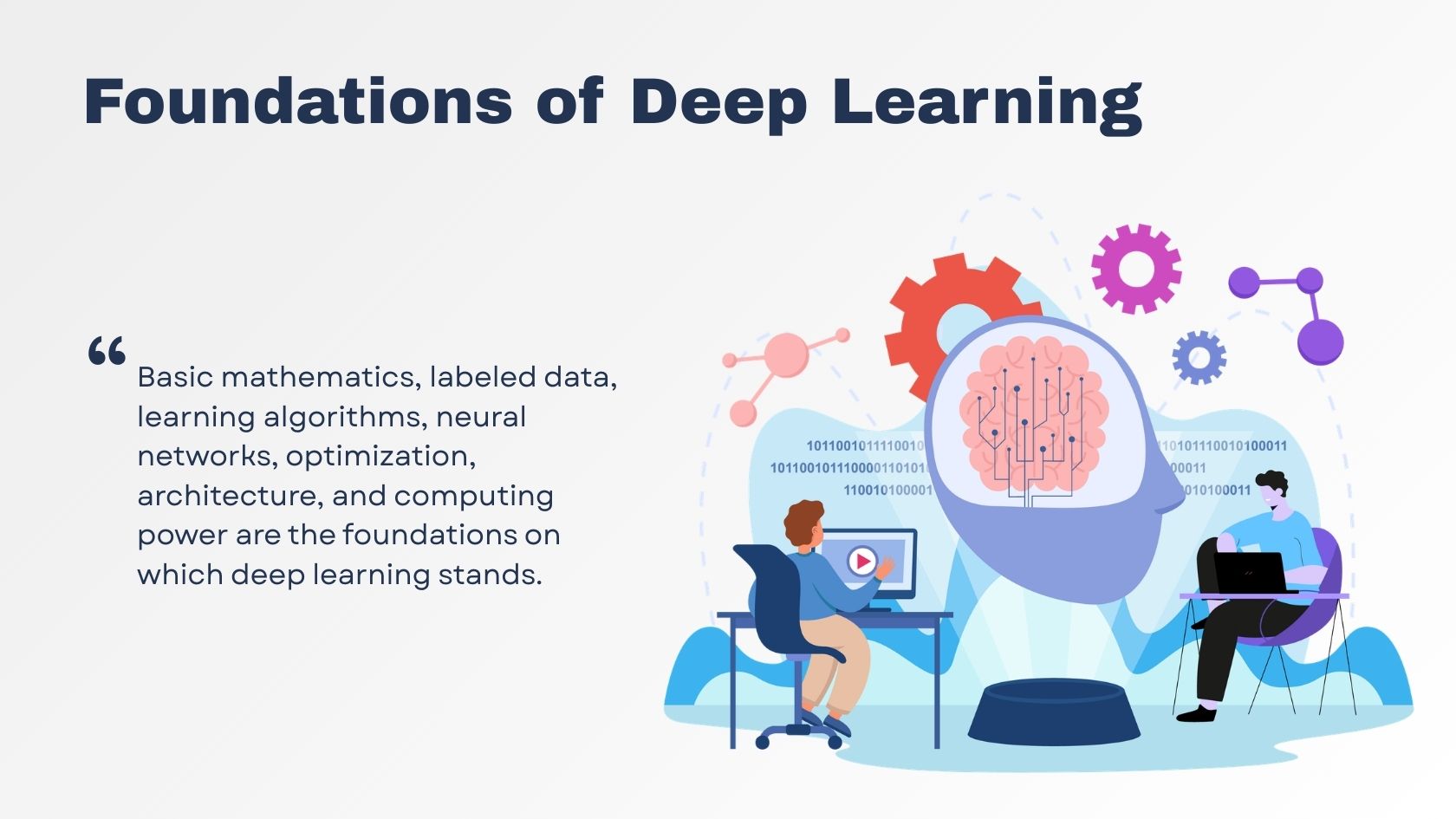
Basic mathematics, labeled data, learning algorithms, neural networks, optimization, architecture, and computing power are the foundations of deep learning.
It may seem complicated, but you need a solid grasp of the basics to begin, not advanced theory.
For instance, many beginners jump straight into frameworks such as TensorFlow or PyTorch without prior understanding, which leads to confusion from the start.
You must first be comfortable with basic programming (typically Python), machine learning concepts, mathematical functions and equations, and neural network fundamentals.
Then come the activation functions, learning algorithms, data handling, model evaluation, overfitting, regularization, and frameworks.
Key Areas to Strengthen Foundations
Here are a few concepts you need to focus on when starting with deep learning.
|
Topic |
Key Concepts |
|
Linear Algebra Basics |
Vectors, matrices, and matrix multiplication |
|
Probability and Statistics |
Distributions and mean squared error |
|
Calculus Basics |
Derivatives and gradients |
|
Python Programming |
NumPy and data handling |
|
Classical Machine Learning |
Regression and decision trees |
II. Understanding the Neural Networks
After understanding the basics, you need to build a strong conceptual paradigm of how neural networks actually work.
A neural network is a computer model that learns to make decisions or predictions by processing information through layers of interconnected “neurons.”
Each neuron takes inputs, applies weights, passes them through an activation function, and produces an output.
Your practice involves adjusting weights based on the error signal using the feedback loop. Visualize how data flows through the layers and how errors guide improvement, so you don't feel lost during model training.
When you understand concepts such as overfitting, underfitting, and generalization, you will begin exploring complex architectures such as CNNs or transformers.
Here is a step-by-step process to build strong conceptual clarity
|
S.No |
Topic |
Key Focus |
|
1 |
Forward Propagation |
Learn how it works through simple diagrams. |
|
2 |
Loss Functions |
Understand why models try to minimize error. |
|
3 |
Gradient Descent |
Study optimization strategies. |
|
4 |
Building Neural Networks |
Practice building small ones from scratch. |
|
5 |
Hyperparameters |
Experiment with learning rate and batch size. |
III. Mastering Deep Learning Tools and Frameworks
Frameworks like PyTorch, TensorFlow, and Keras make deep learning accessible, but they can also create dependencies that are hard to understand.
Don’t just copy tutorials. Learn how frameworks turn concepts into code. When you know why something works, switching between tools becomes easy.
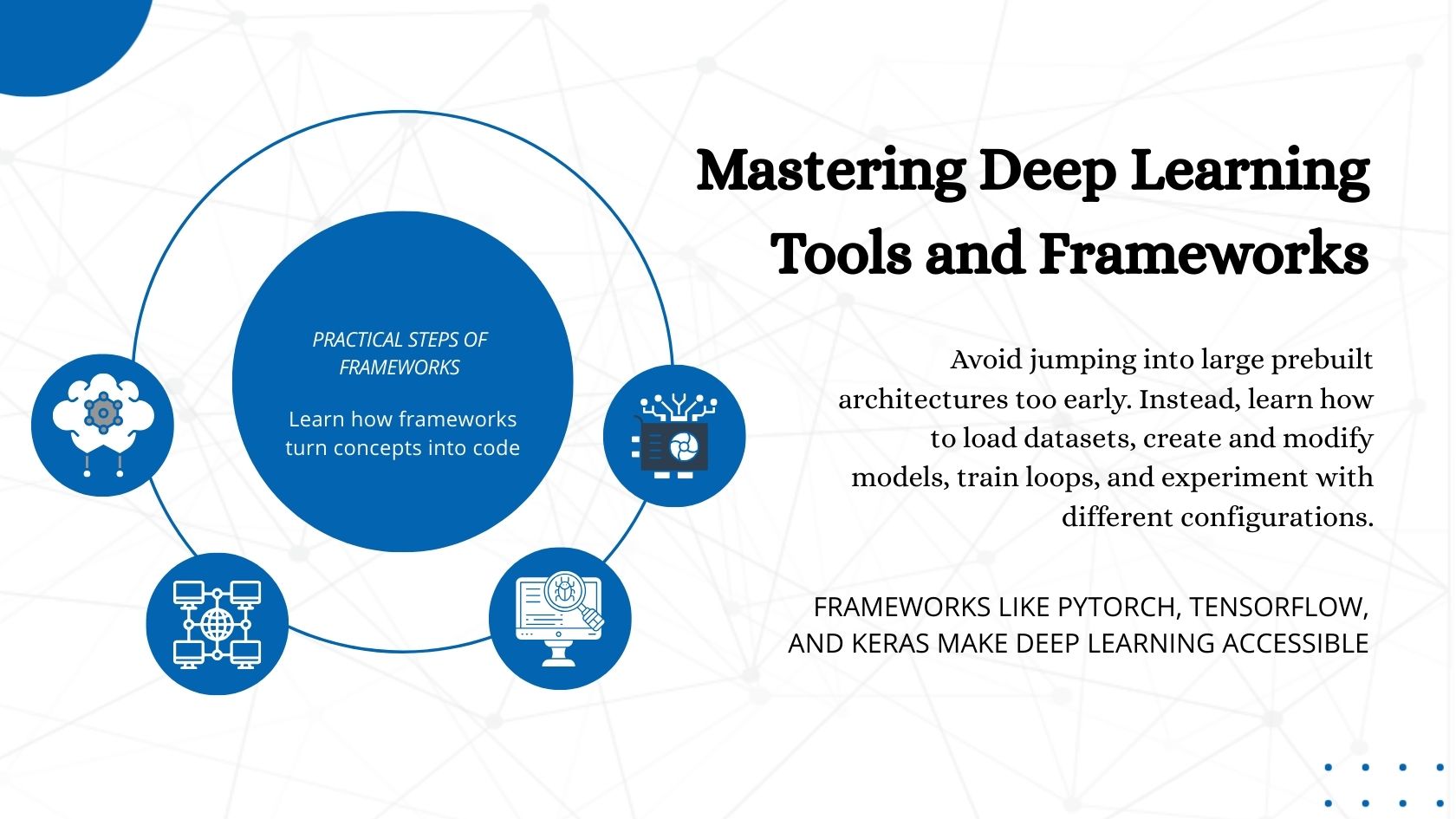
Avoid jumping into large prebuilt architectures too early. Instead, learn how to load datasets, create and modify models, train loops, and experiment with different configurations.
Practical Steps for Mastering Frameworks
Here is the step-by-step process to master deep learning frameworks.
|
Topic |
Key Expansion and Focus Areas |
|
Begin with PyTorch or TensorFlow Basics |
Master tensors, operations, autograd/gradients, and basic modules. Choose PyTorch for flexibility or TensorFlow for production; follow official tutorials for installation and simple computations. |
|
Implement Simple Networks |
Build logistic regression (single-layer classifier with sigmoid) and MLP (multi-layer with ReLU); use datasets like MNIST, write training loops, and evaluate accuracy to understand full pipelines. |
|
Learn Debugging Techniques and Error Analysis |
Use random seeds for reproducibility, perform gradient checks for verification, monitor training/validation losses to prevent overfitting, and use confusion matrices/visualizations for post-training insights. |
|
Practice Using GPU Acceleration |
Set up CUDA, move models to the GPU, compare training speeds between CPU and GPU, optimize with batching/mixed precision, and use tools like Colab to handle large-scale computations efficiently. |
IV. Learning through Projects Instead of Only Courses
One of the biggest mistakes learners make is relying solely on theory and video tutorials, which do not build real skill.
Deep learning mastery comes from developing projects that solve real problems. Projects force you to make decisions, troubleshoot errors, and understand data deeply.
It is where true learning happens. Choose problems that you like because curiosity makes learning faster and more enjoyable. You may start with simple projects such as image classification or sentiment analysis.
You may also document your projects and share them publicly to build a strong professional portfolio.
Project Ideas to Build Practical Experience
- Handwritten digit recognition using the MNIST dataset.
- Movie review sentiment analysis.
- Image classification using transfer learning.
- Chatbot creation using sequence models.
- Time series forecasting with neural networks.
V. Exploring Advanced Architectures and Real-World Applications
After building foundational skills and project experience, you should begin exploring advanced architectures, including convolutional neural networks (CNNs) for image processing, recurrent neural networks (RNNs) and transformers for sequence modeling, and generative models like GANs.
Remember, understanding when and why to use each architecture is more important than memorizing structures.
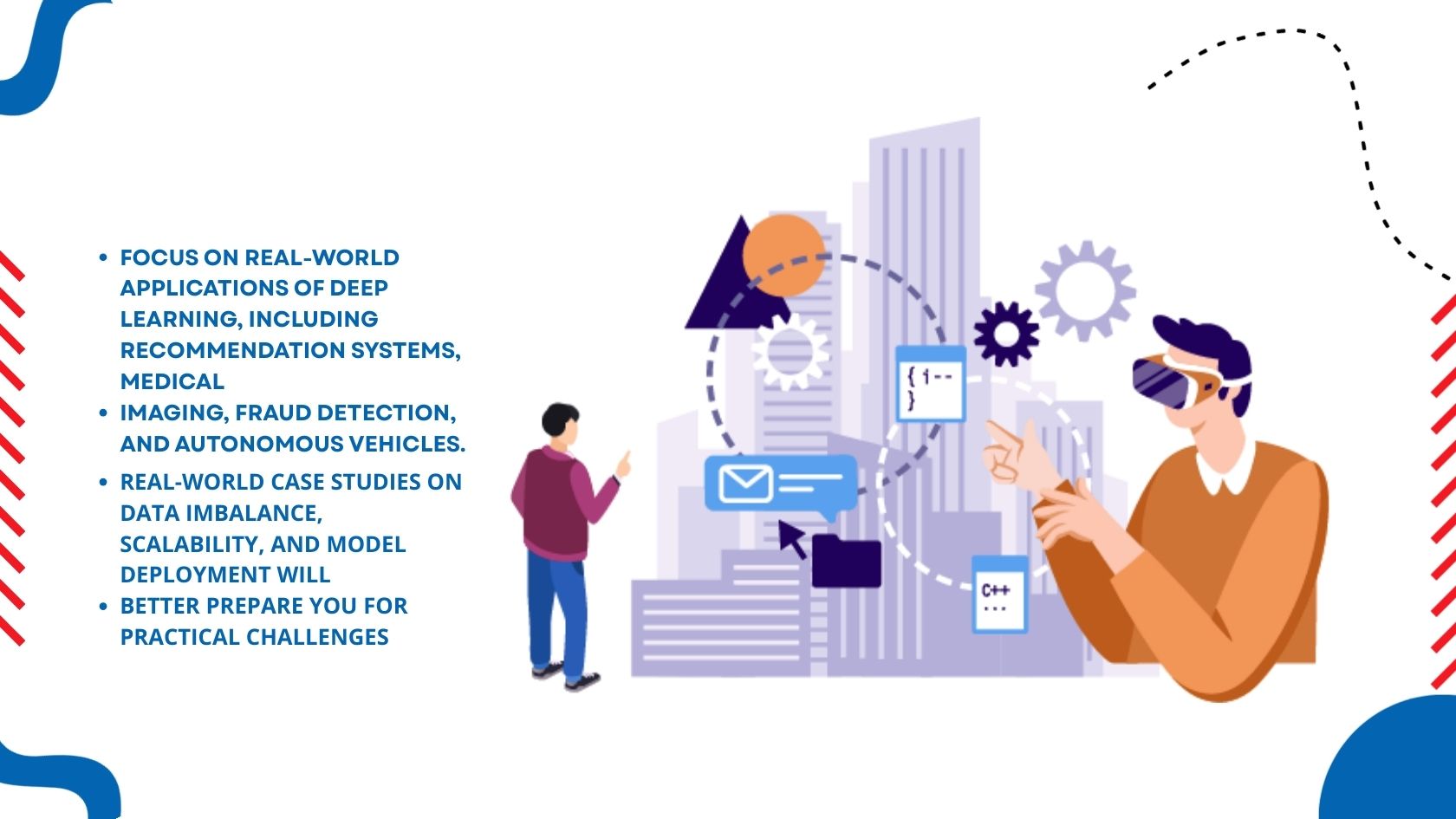
Focus on real-world applications of deep learning, including recommendation systems, medical imaging, fraud detection, and autonomous vehicles.
Moreover, real-world case studies on data imbalance, scalability, and model deployment will better prepare you for practical challenges.
Important Advanced Topics to Explore
- Transfer learning and pretrained models.
- Attention mechanisms and transformers.
- Model regularization and dropout techniques.
- Hyperparameter tuning strategies include manual, grid, and random search.
- Deployment using APIs or cloud platforms.
VI. Developing a Long-Term Strategy and Learning Regularly
Deep learning evolves rapidly. New models, techniques, and research appear constantly. Maintain a reading discipline and build habits that allow you to continue growing over time.
Here is a brief study plan to help you progress from novice to expert deep learning engineer.
|
Time Frame |
What to Learn |
Tools/Resources |
|
Weeks 1-2: Building Foundations |
Focus on core math and programming prerequisites. Master linear algebra (vectors, matrices, multiplication), probability/statistics (distributions, mean squared error), calculus (derivatives, gradients). Learn the basics of Python, including data handling with NumPy and Pandas. Understand why these are essential to understanding how neural networks process and optimize data. |
Python IDE (e.g., VS Code, Jupyter Notebook); Libraries: NumPy, Pandas, Matplotlib; Free resources: Khan Academy for math, "Python Crash Course" book, Coursera’s "Mathematics for Machine Learning" specialization. |
|
Weeks 3-4: Introduction to Machine Learning |
Dive into classical ML algorithms like linear/logistic regression, decision trees, random forests, and clustering (e.g., K-Means). Learn supervised vs. unsupervised learning, evaluation metrics (accuracy, precision, recall, F1-score), and basic data preprocessing (scaling, encoding). This builds intuition for pattern recognition before deep learning specifics. |
Scikit-learn library; Datasets from Kaggle (e.g., Iris, Titanic); Tutorials: Scikit-learn docs, Andrew Ng's "Machine Learning" on Coursera, "Hands-On Machine Learning with Scikit-Learn" book by Aurélien Géron. |
|
Weeks 5-6: Neural Networks Fundamentals |
Explore core concepts: Forward propagation (data flow through layers), loss functions (e.g., MSE, cross-entropy), and why minimizing error matters, gradient descent (optimization strategies like SGD, Adam), and backpropagation. Build small neural networks from scratch in code to grasp internals. Experiment with hyperparameters (learning rate, batch size). |
Python with NumPy for from-scratch implementations; Visual tools: TensorFlow Playground (playground.tensorflow.org) for interactive simulations; Resources: 3Blue1Brown's Neural Networks video series, fast.ai's Practical Deep Learning for Coders (free course). |
|
Weeks 7-8: Frameworks and Simple Models |
Get hands-on with deep learning libraries. Start with PyTorch or TensorFlow basics (tensors, autograd). Implement simple models: logistic regression for classification and a Multilayer Perceptron (MLP) for more complex tasks. Learn data loading, training loops, and basic evaluation. |
PyTorch or TensorFlow/Keras; Google Colab for free GPU access; Datasets: MNIST, CIFAR-10 via torchvision or tf.keras.datasets; Tutorials: Official PyTorch/TensorFlow quickstarts, "Deep Learning with Python" by François Chollet. |
|
Months 2-3: Debugging, Optimization, and Intermediate Models |
Master debugging: Set random seeds for reproducibility, gradient checking, monitor training/validation losses to detect overfitting/underfitting, and error analysis (confusion matrices). Practice GPU acceleration for faster training. Build intermediate models, such as Convolutional Neural Networks (CNNs) for images and Recurrent Neural Networks (RNNs/LSTMs) for sequences. Learn regularization (dropout, L2), batch normalization. |
Weights & Biases or TensorBoard for logging/metrics; NVIDIA CUDA for GPU setup; Resources: Debugging guides from PyTorch docs, Coursera's "Neural Networks and Deep Learning" by deeplearning.ai, Kaggle competitions for practice. |
|
Months 4-6: Advanced Architectures and Applications |
Study transformers, attention mechanisms, and models like BERT for NLP, ResNet for computer vision, and GANs for generative tasks. Learn transfer learning (fine-tuning pre-trained models), handling imbalanced data, and ethical AI considerations (bias, fairness). Apply to real-world domains: Image classification, text generation, time-series forecasting. |
Hugging Face Transformers library; Pre-trained models from Model Zoo (PyTorch Hub or TensorFlow Hub); Resources: "Transformers for Natural Language Processing" book, Stanford's CS224N (NLP) or CS231N (CV) lectures (free online), Papers with Code website for implementations. |
|
Months 7+: Projects, Specialization, and Deployment |
Undertake end-to-end projects: build a chatbot, an object detector, or a recommender system. Specialize in areas like reinforcement learning or federated learning. Learn model deployment (e.g., to web apps), production monitoring, and scaling. Contribute to open-source or participate in hackathons to solidify skills. |
Streamlit or Flask for deployment; Cloud platforms: AWS SageMaker, Google Cloud AI, or Heroku; Resources: Kaggle notebooks for inspiration, the "Deep Learning Specialization" on Coursera, GitHub repos for project ideas, and communities like Reddit's r/MachineLearning or the fast.ai forums for feedback. |
Strategies For Continuous Growth
- Create a learning routine that balances theory, coding practice, and experimentation.
- Read research summaries instead of full papers initially.
- Join AI communities and forums.
- Follow industry blogs and conferences.
- Contribute to open-source deep learning projects.
- Build personal experiments with new datasets.
Resources
Mastering deep learning is about building strong foundations, understanding concepts clearly, and practicing through real projects.
By following a structured path, you turn confusion into intuition, understand complex architectures, and turn challenges into learning opportunities.
- ·TensorFlow: A widely used open-source library for machine learning and deep learning, developed by Google. It provides a comprehensive ecosystem for building and deploying models for tasks like image recognition and natural language processing.
- PyTorch is another leading open-source deep learning framework, known for its flexibility and ease of use with Python. It is a popular choice for research and applications, with major commercial architectures built on it.
- Deep Learning Book: A comprehensive online textbook by Ian Goodfellow, Yoshua Bengio, and Aaron Courville, intended to help students and practitioners enter the field. It is available for free online and covers a wide range of topics.
- Kaggle is a community platform offering valuable datasets, coding environments (kernels/notebooks), and competitions where users share solutions and code. It is an excellent resource for hands-on practice and learning from others' work.
- 3Blue1Brown Neural Networks Series A YouTube playlist by Grant Sanderson that provides an intuitive understanding of the underlying mathematics (linear algebra and calculus) of neural networks through excellent visualizations.
Related Post

RECOMMENDED POSTS


RECOMMENDED TOPICS
TAGS
- artificial intelligence
- agentic ai
- ai
- machine learning
- deepseek
- data science
- llm
- growth engineering
- ai/ml
- saas
- chatgpt
- ai development
- gpt
- openai
- application
- cloud storage
- api based architecture
- modular saas
- mobile development
- scalable architecture
- software engineering
- enterprise security
- aws
- api
- social influencers
- social media marketing
- social media
- cloud optimization
- gcp
- deep learning
- python
- user experience
- app development
- user interface
- data analysis
- data pipeline
- generative ai
- deepfake
- cybersecurity
- bot
- offshoring
- outsourcing
- captive center
- blockchain
- data security
- modern medicine
- climate change
- llm models
- leadership
- it development
- empathy
- static data
- dynamic data
- ai model
- open source
- xai
- qwenlm
- bpa
- automation
- healthcare
- cloud management
- growth hacks
- data roles
- data analyst
- data scientist
- data engineer
- data visualization
- productivity
- database management
- sql query
- data isolation
- db expert
- database optimize
- customer expectation
- sales growth
- test
- artificial intelligene
ABOUT
Stay ahead in the world of technology with Iowa4Tech.com! Explore the latest trends in AI, software development, cybersecurity, and emerging tech, along with expert insights and industry updates.
Comments(0)
Leave a Reply
Your email address will not be published. Required fields are marked *