API-Centric Architecture: The Present & Future of SaaS
SaaS success today isn’t about building the biggest platform—it’s about building the right one. Many new SaaS fail not because they lack features, but because they are too rigid to evolve or scale with users’ increasing demands.
Modular SaaS flips that model. Instead of forcing every customer into a single monolithic system, it lets businesses start small—say, with user management or billing—and add capabilities such as analytics, automation, or integrations only when needed.
This approach accelerates launches, reduces technical debt, lowers costs, and makes scaling predictable.
In this article, we explore how Modular SaaS creates faster paths to market, smoother expansion, and sustainable, long-term revenue growth for startups and enterprises alike.
What Is Modular SaaS?
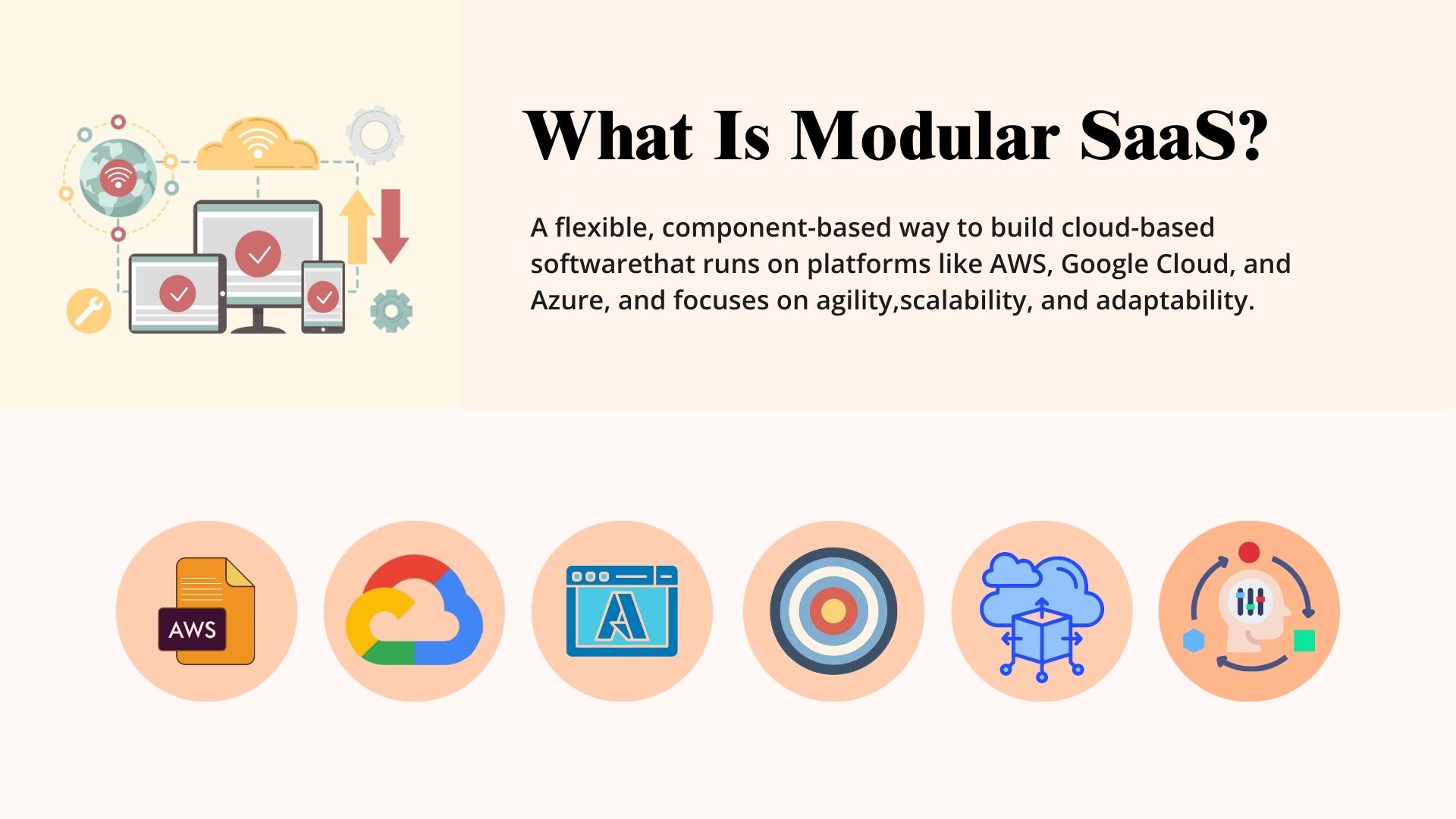
Modular SaaS is a flexible, component-based approach to building cloud-based software that runs on platforms such as AWS, Google Cloud, and Azure, with a focus on agility, scalability, and adaptability.
Users get self-contained functional components, such as billing, analytics, CRM, automation, or reporting, that work independently yet connect via APIs, with 100% scalability.
Here is an interesting comparison between monolith or traditional SaaS and modular SaaS.
Monolithic SaaS vs. Modular SaaS
While monolithic platforms bundle everything together, modular SaaS breaks features into independent, flexible components, giving teams greater control.
|
Monolith SaaS |
Modular SaaS |
|
1. All features, like authentication, billing, reporting, analytics, and integration, are built into one large codebase. |
1. Each feature exists as a separate module connected through APIs. |
|
2. Developed and deployed as a single entity, often sharing a single database. |
2. Developed, deployed, and scaled individually, not necessarily sharing a single database. |
|
3. A change in one area often affects the entire system. |
3. Change in one module does not affect the entire system. |
|
4. Limited flexibility and slower updates due to interdependencies. |
4. Highly flexible and faster iteration since teams can develop and release features independently. |
|
5. Pricing is flat or tiered with many unused features included. |
5. Pricing is usage-based or an add-on that supports gradual growth. |
How Modular SaaS or API-Centric Architecture Empowers Enterprises
By mid-2010, modular SaaS had become a clear market trend, driven by cheaper, more reliable cloud infrastructure, the growth of cloud-native systems, easier API and microservices, crowded SaaS markets, and evolving customer behavior.
Modular SaaS didn’t appear overnight. It evolved with the rise of enterprises offering software as a service to everyday users, who accessed it on personal laptops and smartphones.
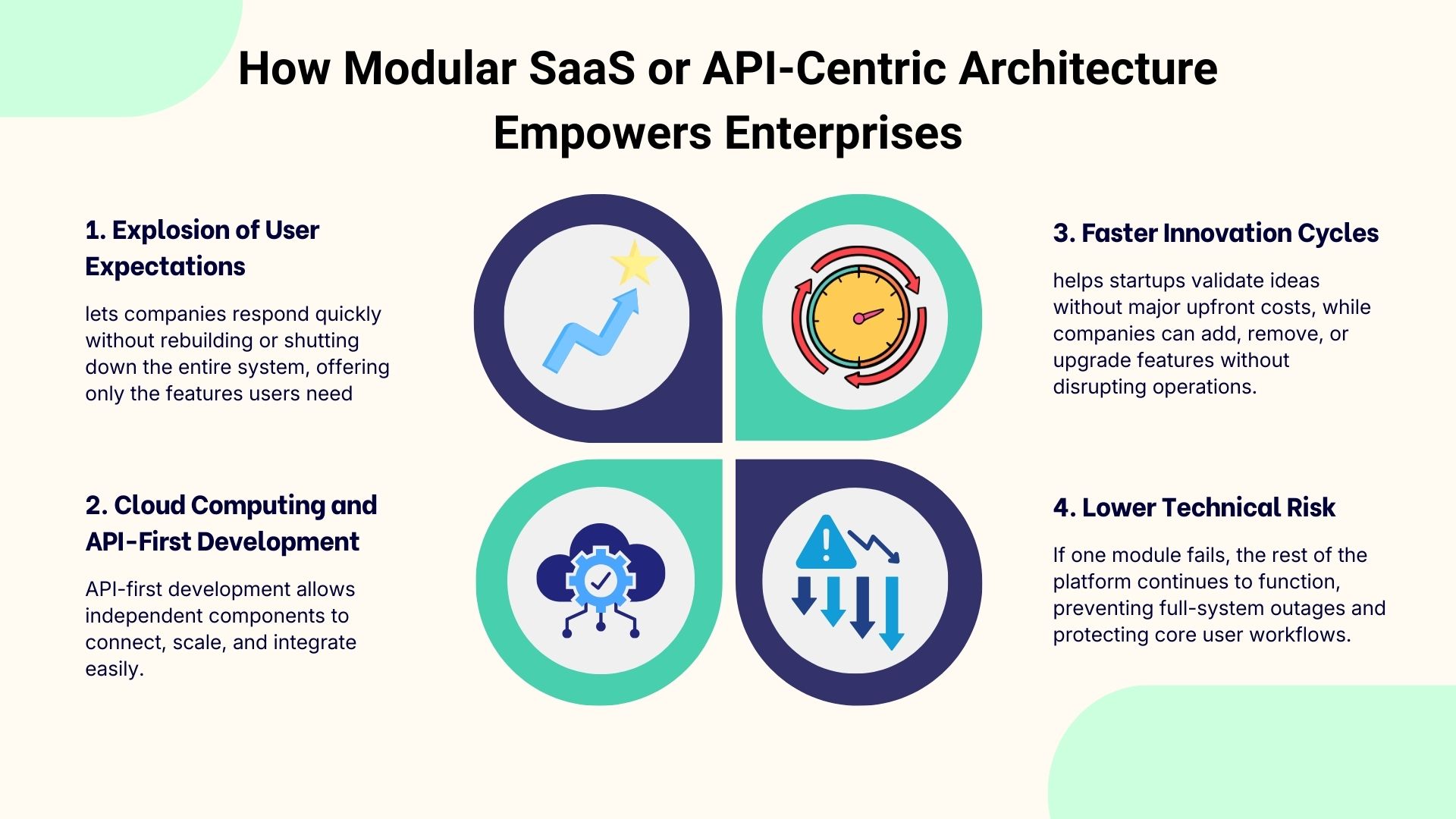
1. Explosion of User Expectations
Modern users expect software to be fast, customizable, always available, and seamlessly integrated.
Moreover, a survey of U.S. SaaS users also shows that nearly 60% users abandon rigid or outdated platforms.
Modular SaaS lets companies respond quickly without rebuilding or shutting down the entire system, offering only the features users need.
2. Cloud Computing and API-First Development
Cloud platforms such as AWS, Azure, and Google Cloud make modular SaaS practical and affordable.
API-first development allows independent components to connect, scale, and integrate easily.
Today, over 80% of SaaS applications use APIs to enable modular development and smooth third-party integrations.
3. Faster Innovation Cycles
Modular SaaS enables innovation by allowing teams to launch new modules, test with real users, and improve continuously.
It helps startups validate ideas without major upfront costs, while companies can add, remove, or upgrade features without disrupting operations.
4. Lower Technical Risk
If one module fails, the rest of the platform continues to function, preventing full-system outages and protecting core user workflows.
Teams can deploy changes (bugs, performance issues, or security flaws) to each module without disrupting the overall product stability, reducing damage and downtime.
Why Should You Opt for Modular SaaS?
If you want control over each feature with customization without complexity and are bugged by poor scalability and integration issues, then modular SaaS should be your choice.
According to industry research, over 70% of SaaS companies report that scalability and integration challenges slow down innovation as they grow.
Modular is enabled by an API-first architecture that speeds development, supports product-led growth, and future-proofs platforms.
|
Perspective |
What Modular SaaS Delivers |
Why It Matters |
|
Users |
Faster feature updates |
Improvements roll out without disrupting the entire platform |
|
Fewer system-wide outages |
Isolated modules reduce the blast radius of failures |
|
|
Personalized software experience |
Users activate only what they need, avoiding clutter |
|
|
Seamless integrations |
Modules connect easily with other tools and workflows |
|
|
Usage-based pricing & upgrades |
Users pay for value, not unused features |
|
|
Businesses |
Faster time-to-market |
Launch core features first and expand without rework |
|
Lower long-term maintenance costs |
Smaller, independent modules are easier to manage |
|
|
Easier scalability |
Scale features independently based on demand |
|
|
Stronger competitive advantage |
Adapt faster than rigid, all-in-one competitors |
How Enterprises Can Benefit from Future Modular SaaS
Modular and API-centric architectures are the future of software technology. Whether hard-coding, using a low-code or no-code platform, or implementing AI, every application will adopt an API-centric architecture.
Here is how the future is unfolding.
1. AI Will Be Delivered as Plug-In Modules
AI is shifting from built-in features to independent, plug-and-play modules.
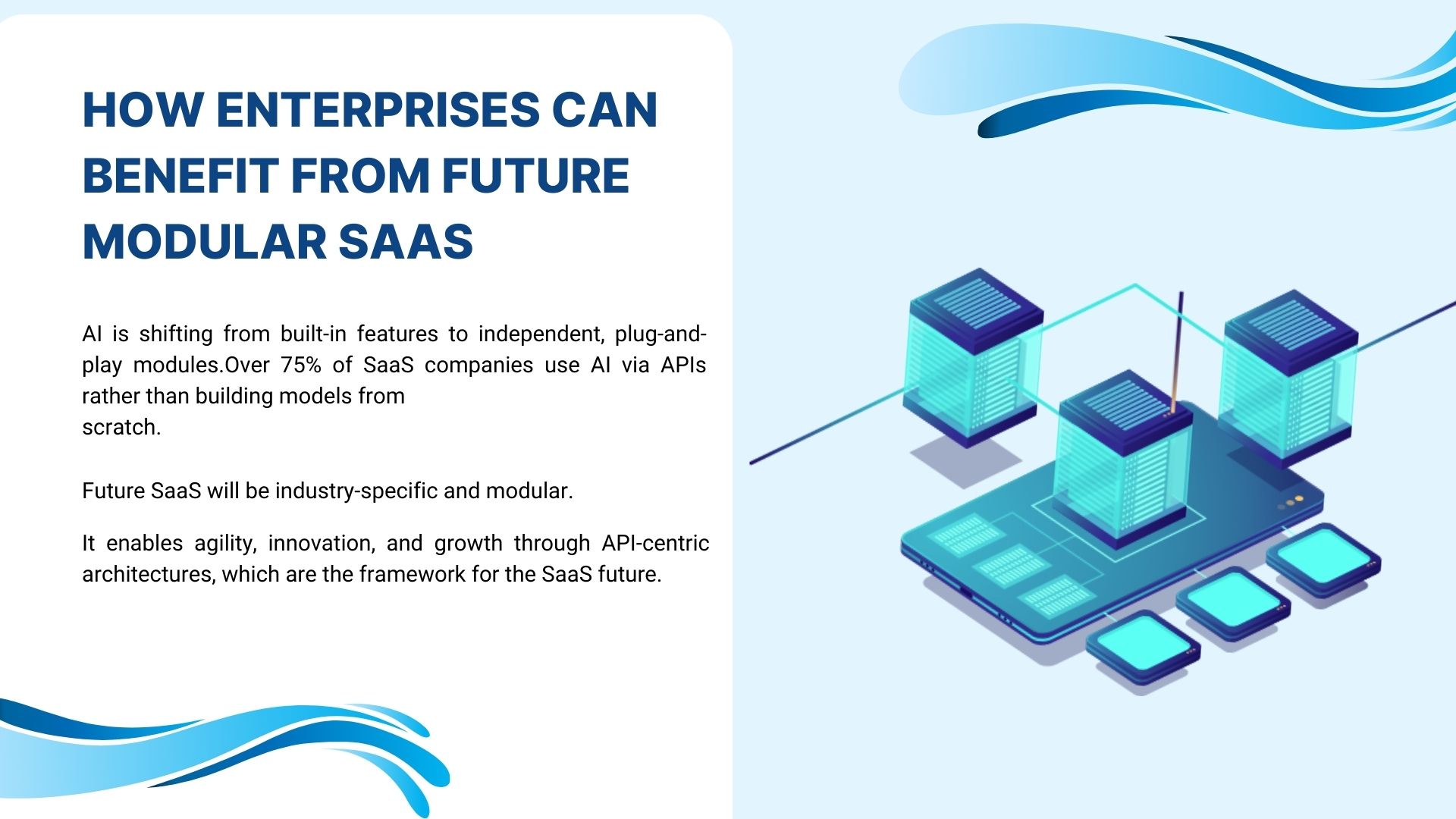
Modular AI allows businesses to add, upgrade, or remove features without downtime, increasing revenue and reducing risk.
Why is this happening
- AI models evolve quickly, allowing modular delivery for faster upgrades.
- AI workloads demand flexible scaling.
- Not every user needs every AI feature.
AI-powered add-ons increase SaaS revenue per user by up to 25%, according to product growth studies.
What this means is that in the near future, a SaaS platform can
- Add AI recommendations as a module.
- Offer AI analytics as a premium add-on.
- Swap older models for newer ones without downtime.
2. No-Code Tools Will Consume APIs
No-code and low-code platforms are exploding in popularity, and APIs are the fuel powering them. From 2023 to 2025, low-code/no-code development grew by 20%, and studies suggest it will grow by over 70% by 2027.
Instead of writing backend logic, users connect visual workflows to existing APIs.
Modular SaaS products expose their features through APIs, making them instantly usable inside no-code platforms.
Why this matters
- Businesses want speed, not complexity.
- Non-technical users want control.
- IT teams want fewer bottlenecks.
- API-first SaaS products integrate 3× faster with no-code platforms.
With modular, API-driven SaaS
- Marketing teams can automate workflows without engineers.
- Educational institutions can build internal tools for students, staff, and teachers.
- Startups can launch products with smaller tech teams.
3. Industry-Specific SaaS Ecosystems Will Expand
Future SaaS will be industry-specific and modular. It is so because modular platforms reduce customization costs by 35–50% in regulated industries.
For example, an education SaaS with modules for attendance, assessments, analytics, and compliance.
Similarly, there are healthcare SaaS platforms with plug-in modules for billing, records, and reporting, as well as legal and finance SaaS platforms.
Why industries prefer modular ecosystems
- Regulations differ by sector
- Workflows are highly specialized
- Integrations vary widely
Modular, API-driven ecosystems allow companies to adapt to industry needs without rebuilding the core product.
Conclusion
The rise of Modular SaaS, powered by API-first thinking, represents a fundamental shift in how software is built and scaled.
It enables agility, innovation, and growth through API-centric architectures, which are the framework for the SaaS future.
So, are you ready to build a modular, API-first SaaS? Contact Searchable Design, the most reliable SaaS app development company in the U.S.
Related Post

RECOMMENDED POSTS


RECOMMENDED TOPICS
TAGS
- artificial intelligence
- agentic ai
- ai
- machine learning
- deepseek
- data science
- llm
- growth engineering
- ai/ml
- saas
- chatgpt
- ai development
- gpt
- openai
- application
- cloud storage
- api based architecture
- modular saas
- mobile development
- scalable architecture
- software engineering
- enterprise security
- aws
- api
- social influencers
- social media marketing
- social media
- cloud optimization
- gcp
- deep learning
- python
- user experience
- app development
- user interface
- data analysis
- data pipeline
- generative ai
- deepfake
- cybersecurity
- bot
- offshoring
- outsourcing
- captive center
- blockchain
- data security
- modern medicine
- climate change
- llm models
- leadership
- it development
- empathy
- static data
- dynamic data
- ai model
- open source
- xai
- qwenlm
- bpa
- automation
- healthcare
- cloud management
- growth hacks
- data roles
- data analyst
- data scientist
- data engineer
- data visualization
- productivity
- database management
- sql query
- data isolation
- db expert
- database optimize
- customer expectation
- sales growth
- test
- artificial intelligene
ABOUT
Stay ahead in the world of technology with Iowa4Tech.com! Explore the latest trends in AI, software development, cybersecurity, and emerging tech, along with expert insights and industry updates.
Comments(0)
Leave a Reply
Your email address will not be published. Required fields are marked *