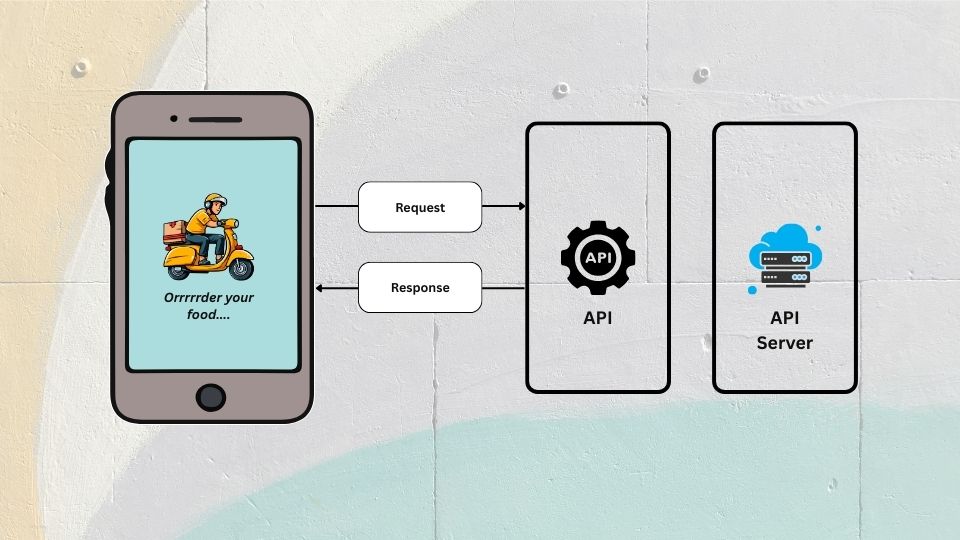
The Digital Plumbing that Scales: Why APIs are the Backbone of Modern Digital Infrastructure
Fast-growing businesses eventually hit the same wall: too many apps and tools, but no easy way to connect them. Data gets stuck, workflows break, and scaling becomes harder than it should be.
APIs solve this by acting as universal connectors that let systems communicate. They move data smoothly, enable new features quickly, and help companies stay fast and flexible without extra manual work.
Here’s a simple breakdown of what APIs do, why an API-first approach matters, and how they power speed and scale in today’s digital infrastructure.
What is API and API Integration?
An Application Programming Interface (API) is a set of rules that allows software components to communicate securely with each other. It manages requests, responses, and permissions so one system can pull data or trigger actions in another.
Did you know that one of the earliest APIs existed to send weather updates to a website, where someone on the other end had to type in the forecast every single day manually?
API integration is the process of connecting applications via their APIs so they can share information and work together automatically. For example,
-
A website showing live weather.
-
A checkout page processing a PayPal payment.
-
A travel app pulling flight information.
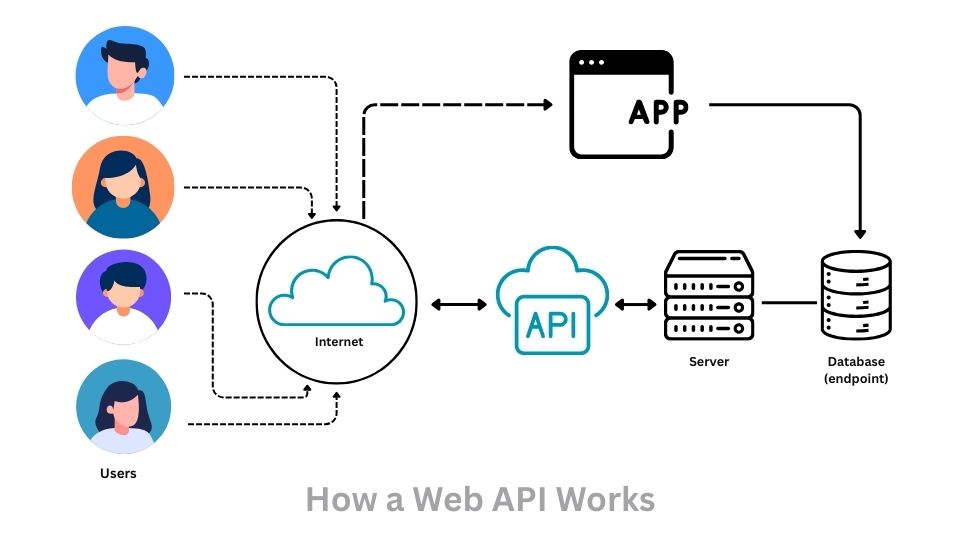
By hiding the complex logic of software behind clean interfaces, API makes it easy for teams to connect tools and build new things faster.
-
Your system sends a request.
-
The API receives it.
-
It talks to another system.
-
It returns the response.
Today, APIs are the backbone of digital products, integrations, and platforms. Whatever you see on the internet is run by APIs.
How APIs Empower Enterprises’ Websites & Apps
Here's how dynamic, optimized APIs empower your websites and applications.
| Benefit | Explanation |
|---|---|
| Speed & Reusability | Developers reuse existing components like login, payments, or search instead of rebuilding them. This shortens development cycles, reduces costs, and gets products to market faster. |
| Seamless Connectivity | APIs connect apps, databases, and platforms so data flows in real time. This eliminates silos and ensures every team works with accurate, updated information. |
| Modularity | Each API handles a straightforward, specific task (such as Orders, Inventory, or Payments). This creates cleaner architecture that’s easier to understand, test, and update without breaking the system. |
| Scalability | APIs allow different parts of a system to scale independently. When traffic spikes, you can plug in new tools or services without disrupting existing infrastructure. |
| Flexibility & Customization | Developers can mix and match tools or build tailored solutions that meet unique business needs. APIs also help craft personalized user experiences and support rapid innovation. |
| Data Insights | By pulling data from multiple sources, APIs provide a unified view of business operations. This enables faster, more informed decisions powered by real-time analytics. |
| Faster Innovation | APIs let teams reuse proven components instead of starting from scratch. This reduces time-to-market and allows safe, fast experimentation. |
| Third-Party Integration & Partner Ecosystems | APIs make it easy to connect with external tools—like maps, payments, CRM, messaging, or social media. This enables collaboration with partners and smooth data exchange. |
| Security & Control | Modern APIs include authentication, encryption, and access controls. Businesses can control who has access to what, keeping data secure across all systems. |
| Automation | APIs automate routine tasks like sending alerts, updating data, and processing transactions. This reduces manual work, minimizes errors, and frees teams to focus on strategy and growth. |
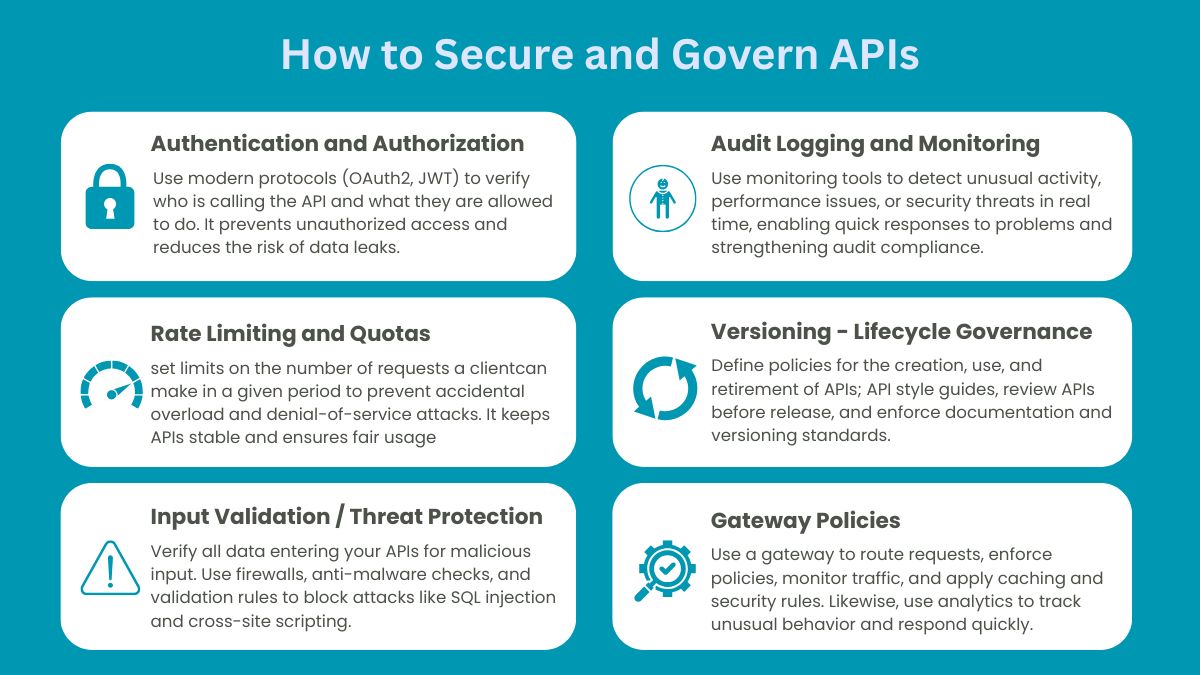
Security and Governance of API: Keeping the Plumbing Safe
Strong governance and security to safeguard websites and apps when you manage thousands of endpoints and serve many clients.
It helps keep your digital plumbing safe, protect sensitive data, and ensure downtime-free operations.
How Enterprises Should Embrace the Future of APIs
As technology evolves, APIs will evolve from simple connectors into intelligent, automated, secure, and deeply integrated building blocks of every digital experience.
Imagine a software that runs totally on APIs from start to end. Almost every “low code, no code” platform relies entirely on APIs to build software; hence, increasing dependence on API-based development.
1. More Intelligent and Autonomous APIs
As companies adopt AI, more capabilities, such as image recognition, language models, and predictions, will be delivered via APIs. With intelligence built into the API layer, systems will anticipate needs, correct errors, and make real-time decisions. An AI-enabled API could spot unusual user behavior and trigger security checks or auto-scale services during peak demand.
2. Real-time APIs Powering Instant Experience
Today’s request–response model (“call the API, get a result”) shifts toward real-time patterns using events, streaming, websockets, and asynchronous messaging.
Real-time APIs will deliver data with near-zero latency, enabling instant tracking, live collaboration, real-time analytics, and interactive apps.
3. Composable Enterprise Architecture Becomes the Standard
Organizations will increasingly design products around APIs from the start.
With an API-first mindset, developers will build more modular, “composable” systems where small services connect like Lego blocks, providing businesses with significant flexibility, enabling faster innovation, and making upgrades easier.
4. Open APIs and Marketplaces (API-Economy Expansion)
APIs will increasingly acquire and evolve in marketplaces (like app stores for APIs), so developers inside and outside a company can discover and use them.
Companies will continue to sell data, services, and capabilities through APIs, just like Stripe sells payments or Twilio sells messaging.
5. Hyper-Automation Through API Ecosystems
As businesses integrate automation tools, APIs will become the core engine connecting ERP, CRM, AI, robotics, supply chains, and more.
APIs will automate end-to-end workflows, from order processing to customer service. We will see leaner operations, fewer manual tasks, and smarter, self-running business systems.
6. Security, Governance, and Zero-Trust Architecture
As the volume of APIs grows, enterprises must invest more in catalogues, management, and monitoring to meet the highest security standards.
The future of APIs demands bulletproof security. Hence, every request must prove its identity and permissions.
7. APIs in IoT, Wearables, and Everyday Devices
As billions of devices connect to the internet, such as cars, appliances, health monitors, and sensors, APIs will become their universal language.
They will help rapid data interaction for connected homes, smarter cities, and automated industries through continuous device-to-device communication.
8. Low-Code and No-Code API Creation
When API development becomes accessible to everyone, visual tools will allow non-engineers to integrate APIs with drag-and-drop interfaces.
It will result in faster adoption, easier experimentation, and broader participation in innovation.
9. Greater Personalization Powered by API Integration
APIs will enable apps to pull information from multiple sources simultaneously to create highly personalized user experiences, such as custom recommendations, real-time data tracking, custom dashboards, or adaptive services.
It will provide deeper customer loyalty and improved engagement.
Watch Out for the Pitfalls
Even though APIs deliver significant benefits, organizations must avoid several pitfalls to maintain long-term scalability across their API ecosystem.
| Challenge | What It Means | How to Fix It |
|---|---|---|
| Poor Documentation | Missing, outdated, or unclear API documentation slows adoption and frustrates developers. | Build a structured developer portal with sample code, SDKs, tutorials, and consistent documentation standards. |
| No Versioning / Breaking Changes | Updating APIs without versioning breaks client applications and disrupts dependent systems. | Use explicit versioning (v1, v2, etc.), maintain backward compatibility, and communicate retirement timelines early. |
| Lack of Governance | Teams build APIs independently, leading to inconsistent naming, duplicate endpoints, unclear ownership, and weak security — creating “spaghetti architecture.” | Form an API governance board, define style guides, approval processes, design standards, security rules, and lifecycle policies. |
| Security Risks | APIs expand the attack surface; without proper controls, they can lead to data breaches and compliance failures. | Enforce strong authentication and authorization, monitor activity, audit logs, apply rate limits, and follow security best practices. |
| Over-Customization / Tight Coupling | APIs designed for a single client become inflexible, hard to maintain, and prone to breaking. | Build general-purpose, decoupled APIs; avoid client-specific logic; design for scalable, long-term use. |
| Ignoring Internal Users | APIs built solely for external users create data silos and duplicate effort for internal teams. | Treat internal teams as first-class API consumers; provide internal catalogs, dashboards, and encourage API reuse across departments. |
Closing Remarks
APIs form the backbone of modern enterprises, connecting systems and enabling smooth collaboration across digital tools.
They simplify adding new features, integrating with partners, and entering new markets while improving customer experiences.
By speeding up development, improving efficiency, and enabling real-time insights, APIs help businesses grow faster and stay competitive.
Ready to build a successful API-first, progressive business? Get in touch with one of the most reliable software developers in the U.S. to jumpstart your digital infrastructure.
Related Post
RECOMMENDED POSTS


RECOMMENDED TOPICS
TAGS
- artificial intelligence
- agentic ai
- ai
- machine learning
- deepseek
- data science
- llm
- growth engineering
- ai/ml
- saas
- chatgpt
- ai development
- gpt
- openai
- application
- cloud storage
- api based architecture
- modular saas
- mobile development
- scalable architecture
- software engineering
- enterprise security
- aws
- api
- social influencers
- social media marketing
- social media
- cloud optimization
- gcp
- deep learning
- python
- user experience
- app development
- user interface
- data analysis
- data pipeline
- generative ai
- deepfake
- cybersecurity
- bot
- offshoring
- outsourcing
- captive center
- blockchain
- data security
- modern medicine
- climate change
- llm models
- leadership
- it development
- empathy
- static data
- dynamic data
- ai model
- open source
- xai
- qwenlm
- bpa
- automation
- healthcare
- cloud management
- growth hacks
- data roles
- data analyst
- data scientist
- data engineer
- data visualization
- productivity
- database management
- sql query
- data isolation
- db expert
- database optimize
- customer expectation
- sales growth
- test
- artificial intelligene
ABOUT
Stay ahead in the world of technology with Iowa4Tech.com! Explore the latest trends in AI, software development, cybersecurity, and emerging tech, along with expert insights and industry updates.
Comments(0)
Leave a Reply
Your email address will not be published. Required fields are marked *