Decentralized Identity + Blockchain 3.0: The Future of Enterprises' Access
Enterprise identity is reaching its breaking point because the old model of creating accounts, storing user data, and controlling access inside one organization no longer fits a world of cloud platforms, APIs, and machines.
Blockchain 3.0 offers trusted credentials that can move securely while identity data remains distributed and under greater user control to tackle trustworthy authentication across organizational boundaries, decentralized identity and
Read on to understand how decentralized identity and Blockchain 3.0 can reshape enterprise access and partner ecosystems.
What Is Decentralized Identity?
Decentralized identity is an identity model that reduces dependence on a single organization or centralized database to store and verify personal information.
Instead of repeatedly creating new accounts and sharing the same identity data across platforms, users or organizations can hold trusted digital credentials and share only the information needed for a specific interaction.
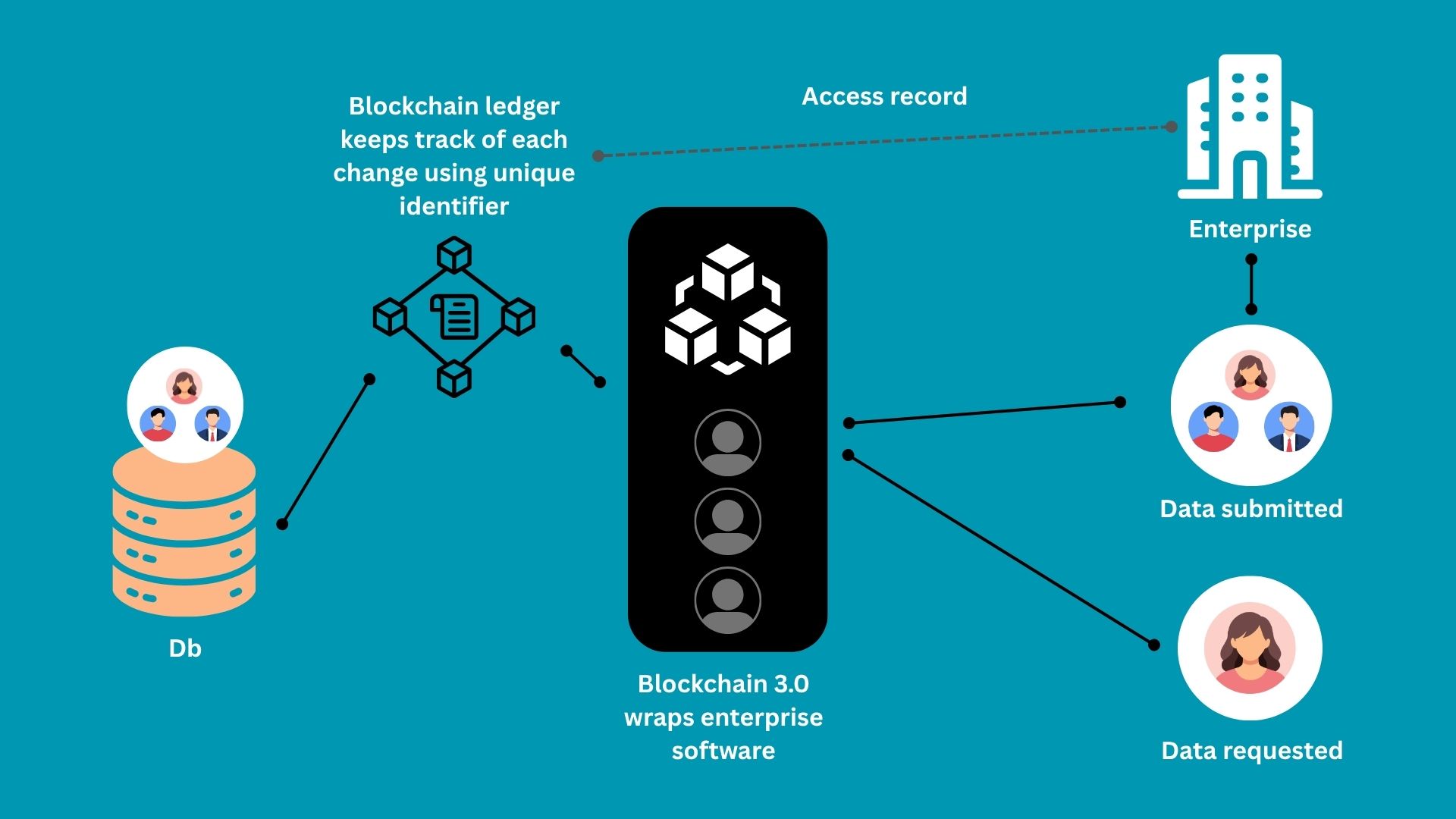
Decentralized Identifiers (DIDs) and Verifiable Credentials (VCs) are the concepts used in this model.
A DID can represent a person, company, device, or service without depending entirely on a traditional identity provider. Verifiable Credentials allow trusted organizations to issue digitally signed claims, such as an employee role, professional certification, supplier status, or access entitlement.
|
# |
Benefit |
Description |
|
1 |
User-controlled identity |
Individuals and organizations gain greater control over how they share identity information. |
|
2 |
Selective disclosure |
Only the information required for a transaction needs to be revealed. |
|
3 |
Portable credentials |
Verified credentials can potentially be reused across multiple trusted systems. |
|
4 |
Reduced duplication |
Enterprises do not need to maintain a separate identity record for every external participant. |
|
5 |
Faster verification |
Partners can validate trusted credentials without repeating lengthy onboarding processes. |
What Is Blockchain 3.0?
Blockchain 3.0 represents the evolution of blockchain beyond cryptocurrency and basic financial applications.
It focuses on practical business use cases such as digital identity, supply chains, healthcare, governance, enterprise collaboration, Internet of Things systems, and cross-organizational data exchange.
In decentralized identity systems, blockchain does not store personal information directly. Instead, it acts as a shared trust layer for verifying identifiers, credential issuers, cryptographic keys, or credential status.
Therefore, sensitive identity data can remain with the individual or organization, while blockchain provides a tamper-resistant mechanism for establishing whether a credential or issuer can be trusted.
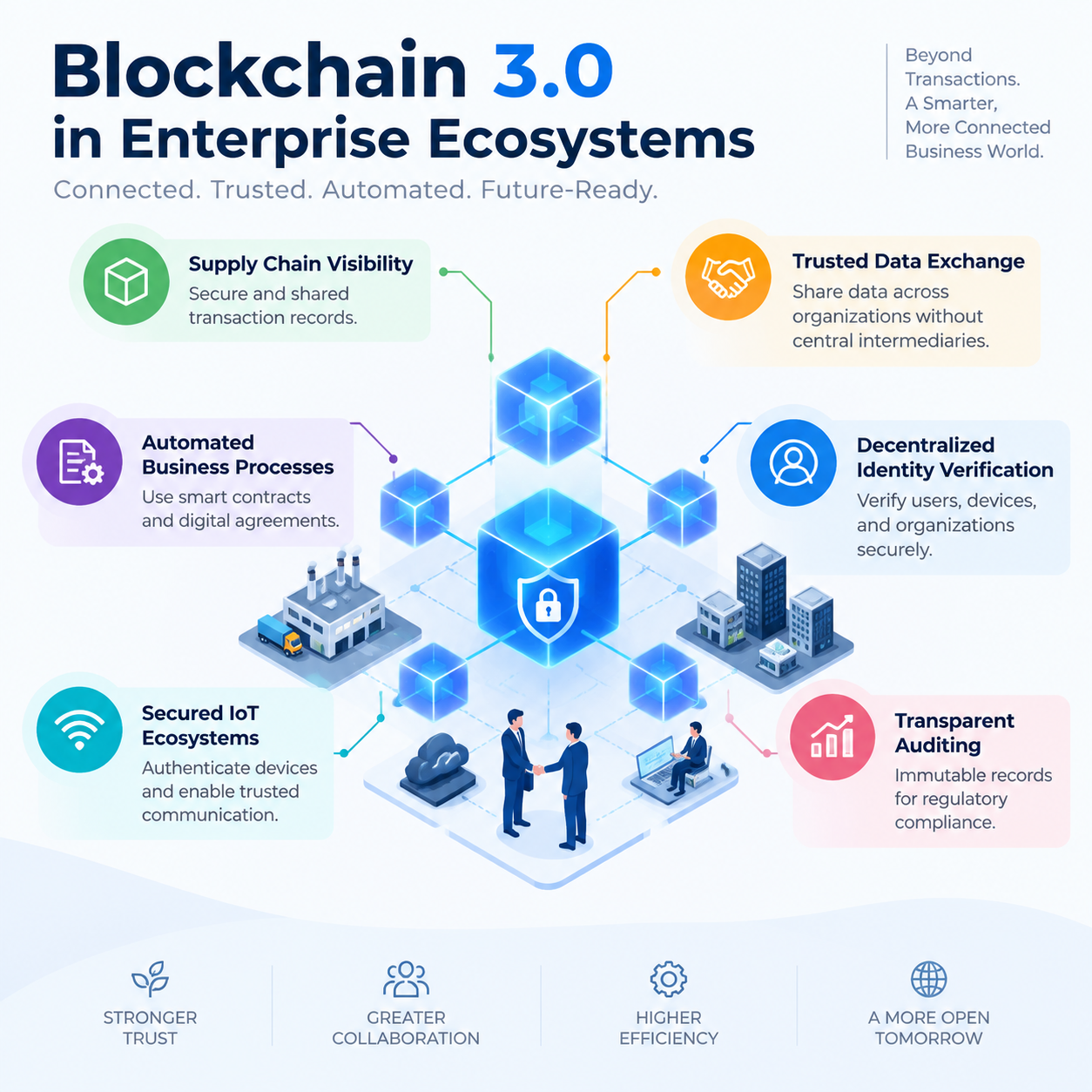
In enterprise environments, Blockchain 3.0 acts as a shared trust infrastructure that enables organizations to collaborate securely without relying on a single central authority.
The Future of Enterprise Access and Partner Ecosystems
The future of enterprise identity is likely to move away from creating a permanent account for every person, supplier, contractor, customer, or machine that needs temporary access.
Instead, organizations can dynamically evaluate trusted credentials and grant access based on verified attributes, policies, and business relationships.
This ecosystem can reshape enterprise access.
|
# |
Benefit |
Description |
|
1 |
Faster partner onboarding |
Suppliers and business partners can present verified company credentials instead of completing the same validation process for every organization. |
|
2 |
Temporary contractor access |
Contractors can receive access based on verified employment, project, or qualification credentials, with permission automatically expiring when the engagement ends. |
|
3 |
Cross-company authorization |
Organizations can recognize trusted roles or certifications issued by approved external parties without creating duplicate identity records. |
|
4 |
Machine and API identity |
Devices, services, workloads, and APIs can use cryptographically verifiable identities to establish trust before communicating. |
|
5 |
Reduced identity duplication |
Enterprises can avoid storing unnecessary copies of personal and organizational information across multiple databases. |
|
6 |
Stronger privacy |
Selective disclosure lets users prove they meet a requirement without exposing unrelated personal data. |
|
7 |
Dynamic access decisions |
Verified credentials can be used with Zero Trust policies, risk signals, device posture, and contextual information before granting access. |
Conclusion
Decentralized identity and Blockchain 3.0 build trust and manage digital identity within enterprises.
Organizations can verify users, devices, and partners securely without depending on centralized identity systems, improving privacy, collaboration, and access control.
If you are looking to build a trusted digital ecosystem, contact Searchable Design. Let’s discuss solutions that improve trust, transparency, and digital collaboration for your business.
Related Post
RECOMMENDED POSTS

RECOMMENDED TOPICS
TAGS
- artificial intelligence
- agentic ai
- ai
- machine learning
- deepseek
- data science
- llm
- growth engineering
- ai/ml
- saas
- chatgpt
- ai development
- gpt
- openai
- application
- cloud storage
- api based architecture
- modular saas
- mobile development
- scalable architecture
- software engineering
- enterprise security
- aws
- api
- social influencers
- social media marketing
- social media
- cloud optimization
- gcp
- deep learning
- python
- user experience
- app development
- user interface
- data analysis
- data pipeline
- generative ai
- deepfake
- cybersecurity
- bot
- offshoring
- outsourcing
- captive center
- blockchain
- data security
- modern medicine
- climate change
- llm models
- leadership
- it development
- empathy
- static data
- dynamic data
- ai model
- open source
- xai
- qwenlm
- bpa
- automation
- healthcare
- cloud management
- growth hacks
- data roles
- data analyst
- data scientist
- data engineer
- data visualization
- productivity
- database management
- sql query
- data isolation
- db expert
- database optimize
- customer expectation
- sales growth
- test
- artificial intelligene
ABOUT
Stay ahead in the world of technology with Iowa4Tech.com! Explore the latest trends in AI, software development, cybersecurity, and emerging tech, along with expert insights and industry updates.
Comments(0)
Leave a Reply
Your email address will not be published. Required fields are marked *